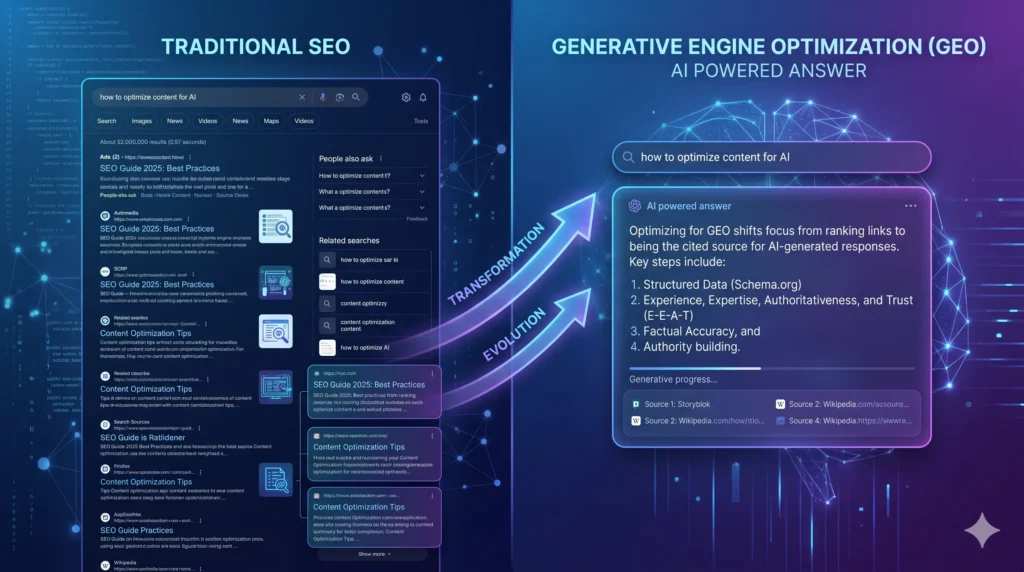
What is GEO? How Generative Engine Optimization Changes SEO in 2026
Introduction
The search landscape is shifting. In 2026, Google doesn’t have a monopoly on discovery anymore.
ChatGPT has 100+ million monthly users. Perplexity is growing 200% YoY. When users ask questions to AI, they don’t click links — they get AI-written summaries citing multiple sources (or not citing them at all).
This is Generative Engine Optimization (GEO). It’s about getting your content cited by AI search engines, not just ranking in traditional SEO.
This guide explains GEO, why it matters, and 8 concrete strategies to get your business cited by AI in 2026.
The AI Search Revolution
The numbers are staggering:
- ChatGPT: 100+ million monthly users, growing 10+ million users/month
- Perplexity AI: 1+ million monthly users, 200% YoY growth
- Google AI Overviews: Appearing in 30–40% of Google searches
- Microsoft Copilot: Integrated into Windows, Edge, Office with 100M+ users
- Indian AI adoption: 40% of Indian internet users now use ChatGPT or Perplexity monthly
These AI search engines are replacing traditional Google search for millions of users. If your business isn’t cited in these AI-generated answers, you’re invisible to these users.
How AI Selects Sources (What Makes You Citable)
AI search engines don’t rank URLs like Google. They cite sources based on trustworthiness. Here’s what they look for:
1. Topical Authority
AI engines prioritize sources that are expert-level on a specific topic. If you’ve written 50+ articles on “SEO in India,” you’re more likely to be cited than a generic business blog with one SEO post.
2. Factual Accuracy
AI engines fact-check content before citing it. Avoid outlandish claims, outdated data, or incorrect statistics. Cite your sources within your content.
3. Entity Recognition
AI looks for structured data about entities (people, companies, places, products). Proper schema markup helps AI understand who you are.
4. Citation Density
If other authoritative sources cite you, AI engines perceive you as trustworthy. Backlinks from .gov, .edu, and industry leaders matter significantly.
5. Content Freshness
AI engines prefer recent content. A blog post updated this week outranks one from 2023, even if the old one is more comprehensive.
GEO vs SEO vs AEO: The Layered Model
These aren’t competing strategies; they’re complementary:
- SEO — Gets you ranked in Google search results
- AEO — Gets you featured as direct answers in snippets
- GEO — Gets you cited by AI search engines like ChatGPT
A complete digital strategy in 2026 covers all three. SEO alone leaves 30%+ of AI search traffic on the table.
8 GEO Strategies: How to Get Cited by AI
1. Build Topical Authority (Publish 50+ Articles on Your Topic)
Pick your core topics. If you’re a digital marketing agency, write extensively on SEO, AEO, GEO, content marketing, social media, etc. Create pillars (comprehensive 3,000+ word guides) and clusters (10–20 supporting articles).
AI engines scan your site, see 50+ high-quality articles on the same topic, and conclude: “This is an authority source on this topic. Cite them.”
2. Accumulate Citations from Authoritative Sources
Backlinks from .gov, .edu, industry publications, and well-known blogs signal authority. A backlink from Mashable or Forbes on SEO is worth 100 backlinks from random blogs.
Strategies: PR outreach (get mentioned in press), guest posting on major publications, earning links through original research, being quoted by journalists.
3. Build Entity Recognition (Claim Your Online Presence)
Ensure your business is recognized across the web:
- Create/verify Google Knowledge Panel
- Claim and optimize Crunchbase, Clutch, G2, AppSumo listings
- Get listed in industry directories and associations
- Maintain consistent name, address, phone (NAP) across the web
- Build LinkedIn company profile with detailed information
4. Implement Structured Data (Schema Markup)
AI engines parse structured data better than text. Implement:
- Organization schema — tells AI who you are
- BreadcrumbList schema — clarifies site structure
- Article schema — dates, authors, word count
- FAQPage schema — Q&A content
- ReviewRating schema — social proof
- Service schema — what you offer
5. Build Platform Presence on Clutch, G2, AppSumo
If you’re a B2B company, Clutch and G2 profiles are goldmines. AI engines treat these platforms as vetted sources. A full profile with reviews significantly increases citation chances. Typical impact: Companies with Clutch profiles get cited 3–5x more often by AI engines.
6. Create AI-Query Optimized Content
AI queries are longer and more specific than Google queries. Someone asking Google might search “SEO cost.” Someone asking ChatGPT might search “What are realistic SEO costs for a mid-size SaaS company in India in 2026?”
Write for these longer, more specific queries. Include concrete numbers, India-specific pricing, detailed comparisons. AI loves nuanced, detailed content.
7. Maintain Fresh Content (Update Regularly)
AI engines crawl often. Content updated this month ranks higher in AI citations than content from a year ago. Establish a content refresh cadence: Monthly — Update stats, add new examples. Quarterly — Review core articles. Yearly — Comprehensive overhaul with new data.
8. Maintain Cross-Platform Consistency
AI engines check multiple sources. If your LinkedIn says “5 years of experience,” your website says “10 years,” and your Clutch profile says “2 years,” AI gets confused and deprioritizes you. Audit all profiles and ensure consistency.
How to Test Your GEO Strategy
Test with ChatGPT
Ask ChatGPT about your industry/service. Do you get cited? What does ChatGPT say about your company?
Test with Perplexity
Visit Perplexity.ai and ask industry questions. Look for your business in the citations. Perplexity is more current than ChatGPT.
Test with Google AI Overviews
Do Google searches and note when AI Overviews appear. Are you cited?
Measure with Tools
Tools like SEMrush and Ahrefs are starting to track AI citations. Monitor for mentions of your brand in AI search results.
How Cogent Coders Helps
We combine SEO, AEO, and GEO into one integrated strategy. Most agencies focus only on SEO. We help you dominate Google search, win featured snippets, AND get cited by AI engines.
Our GEO strategy has helped clients increase citations from AI engines by 200–400% in 6 months. Combined with SEO and AEO, this creates a complete organic traffic machine.
Frequently Asked Questions
Will AI search engines replace Google?
Unlikely. Google is integrating AI into its own search. The future is hybrid: traditional search for page 1 + AI Overviews for direct answers + AI search engines for detailed research.
Do I need to optimize separately for GEO, or does good SEO content work?
How much does GEO cost?
GEO is typically 20–30% of your overall organic strategy cost. Contact us for a free audit.
Conclusion
GEO is not a distant future concern — it’s happening now. Start building topical authority, claiming your entity presence, and optimizing for AI search today. The businesses that master GEO in 2026 will dominate discovery in 2027 and beyond.