
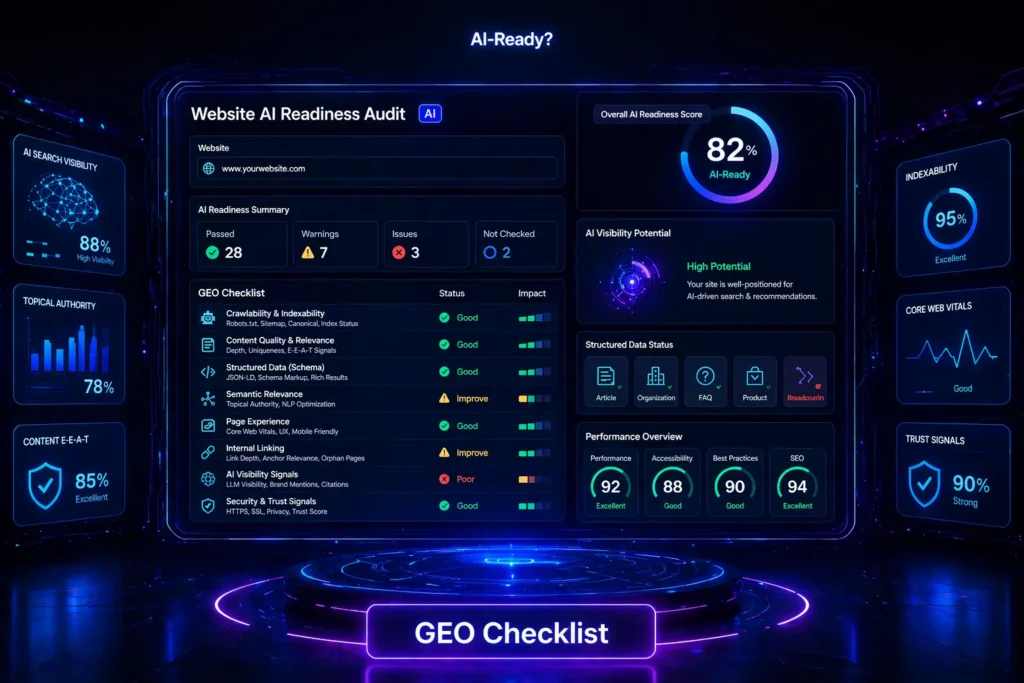
A new shift is happening in search. Traditional search engines (Google, Bing) are integrating AI. ChatGPT now has web search. Perplexity answers research questions. Google Lens suggests products. Claude, Llama, and other AI models consume the web to train and inform answers.
Here’s the problem: AI search engines don’t just look at traditional SEO signals. They evaluate whether your content is factually accurate, comprehensively sourced, clearly structured, and from an authoritative entity. A website that ranks #1 on Google might not be cited by ChatGPT or featured in Google’s AI Overviews.
If AI search engines now influence 30%+ of business research queries (and that number is rising), is your website optimized for AI? This checklist helps you find out. Combine traditional SEO with AEO and GEO for complete 2026 visibility.
An “AI-ready” website has content and structure that AI engines can easily parse, evaluate, and cite. It means:
Traditional SEO optimizes for Google’s algorithmic crawlers. GEO (Generative Engine Optimization) optimizes for AI language models. They overlap but aren’t identical.
AI engines assess whether you’re a genuine authority on your topic. For a health clinic, do you have content on diseases, treatments, preventive care, patient education? For a SaaS company, do you cover product features, use cases, integrations, pricing? A website with 50 blog posts on your topic signals authority more than one with 5 generic posts. Score yourself: do you cover 80%+ of topics within your niche?
AI needs to understand who you are. Is your business entity clearly defined? Do you have a company name, address, team bios, business registration? Create an “About Us” page with company history, team member profiles with photos and credentials, and founding information. Make your entity unmistakable.
If you claim “Over 80% of Americans research doctors online,” AI checks the claim’s validity. Link to the original research. AI models care about factual accuracy because inaccurate answers damage their reputation. Audit your content for unsubstantiated claims. Add citations to statistics, studies, and data.
Schema markup (JSON-LD) tells AI what your content means. Product schema, LocalBusiness schema, FAQPage schema, Author schema — these help AI understand relationships. Implement schema for all critical content types. This is non-negotiable.
AI engines prefer recent, updated content. A blog post from 2020 about 2026 trends is stale. Update important pages regularly. Publish new content consistently. Stale content doesn’t get cited.
AI looks for breadth and depth. A 500-word article on “How to treat acne” is too shallow. Comprehensive content (2,000+ words) covering causes, treatments, prevention, myths, complications, when to see a doctor, etc. gets cited more often.
AI evaluates the author. Is the author an MD writing about medical topics? An architect writing about architecture? Or a random blogger? Every piece of content should have a byline with author credentials, bio, and social profiles. This signals expertise.
Link to peer-reviewed studies, research, data, and credible sources. AI will check your links. Links to reputable sources strengthen your credibility. Broken or sketchy links weaken it.
If you cite a statistic or study, link directly to the source. Transparency helps AI verify your claims. It also helps human readers trust your content.
AI uses FAQ schema to understand your content. Well-structured FAQs with schema markup get cited in AI-generated answers more often. Format FAQs properly with schema.
AI trains on text, images, video, and structured data. Having content in multiple formats (blog post + video + infographic) provides more material for AI to cite and understand.
Backlinks from authoritative sites signal credibility to AI. A website with 500 backlinks from reputable sites gets cited more often than one with 10 backlinks from low-quality sites. Build quality backlinks strategically.
AI cares about engagement metrics. Does your site have low bounce rate? High time-on-page? Mobile-friendly? Fast loading? Positive UX signals correlate with trustworthiness. Optimize your site speed, design, and navigation.
AI checks verified platforms: Google My Business, LinkedIn, Clutch, G2, GoodFirms, industry-specific directories. A business with strong, verified presence across platforms is more credible. Build and maintain these profiles.
AI searches for original content, not regurgitated information. Conduct original research, surveys, case studies, and publish findings. Original insights get cited more often. This differentiates your content.
Audit your website against this checklist. Identify gaps. Prioritize: Fill critical gaps first (factual accuracy, author credentials, schema markup). Then optimize for depth and breadth. The businesses investing in GEO now will dominate AI-driven search in 2026 and beyond.
Start with a free SEO audit to see your specific GEO readiness score and gaps.
No. Both are important and overlapping. Invest in SEO first (it has proven ROI). Then layer GEO on top. By 2027, GEO will be as important as SEO. Start now to stay ahead.
ChatGPT, Perplexity, and Google AI Overviews are leading. But expect 10+ AI search engines in the next 2 years. A website optimized for GEO principles works across all of them.
It’s hard to track directly, but indicators include: high topical authority, strong backlinks, verified business presence, and original research. Use tools like Semrush or Ahrefs to monitor brand mentions and citations over time.
Not fundamentally. SEO best practices (quality content, authority, user experience) also support GEO. Just add the GEO-specific elements: citations, structured data, author credentials, factual accuracy, original research.
Hard to measure yet, but AI search will capture 20–40% of search traffic by 2027. Being cited by AI is massive for brand authority. Check our pricing for GEO-focused packages.
The shift from traditional search to AI search is happening now. Websites optimized for AI — with accurate, comprehensive, well-sourced, and authoritatively presented content — will capture this new wave of visibility. Your website isn’t just competing for Google rankings anymore. It’s competing to be cited by ChatGPT, Perplexity, and a dozen AI search engines.
Run through this 15-point checklist. Fix gaps. Build topical authority. Verify your entity. Cite sources. Implement schema. And remember: the principles are the same. Write accurate, helpful, authoritative content. AI rewards it. So do humans.
Content creator at Cogent Coders, sharing insights on digital marketing, web development, and business growth strategies.