SEO vs Paid Ads: Which is Better for Indian Startups?
Introduction
Every Indian startup faces this question sooner or later: should we invest in SEO or Google Ads? Both promise to bring customers to your website, but they work in fundamentally different ways, on different timelines, and at different costs.
The wrong choice can burn through your limited budget with nothing to show for it. The right choice can set your startup up for sustainable, compounding growth. This post compares SEO and paid advertising head-to-head so you can make the smartest decision for your business stage and budget.
How SEO Works for Startups
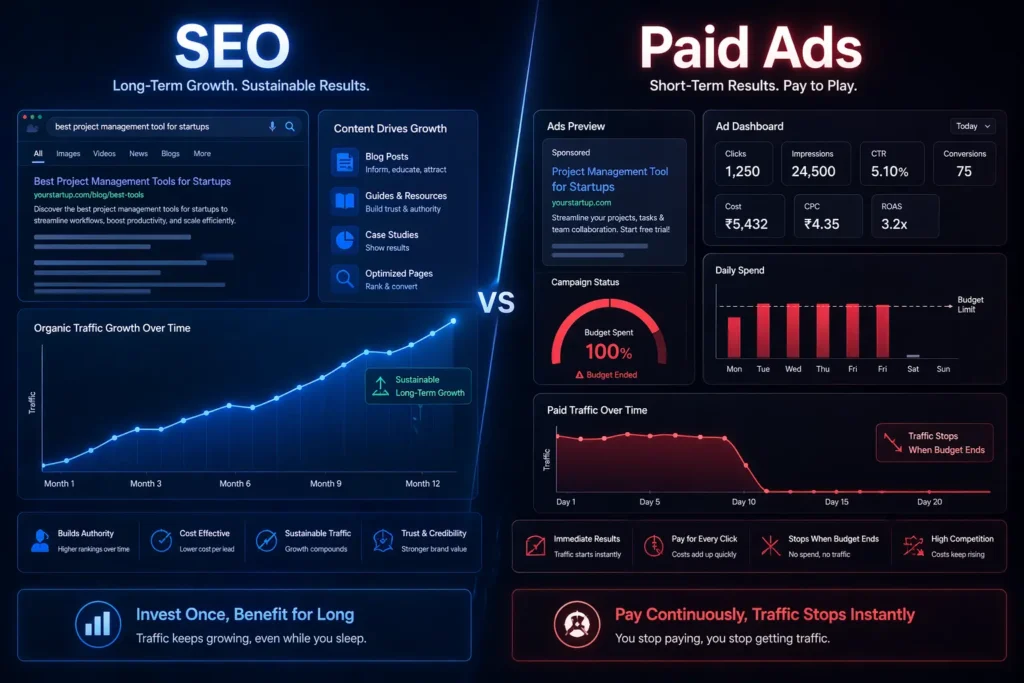
SEO is a long-term strategy that builds your website’s authority and visibility in organic marketing (unpaid) search results. When someone searches for a keyword related to your business, SEO determines whether your website shows up on page 1, page 5, or not at all.
SEO Strengths:
- Compounding returns — traffic grows over time and doesn’t stop when you stop paying
- Higher trust — organic results get 70% more clicks than paid ads for informational queries
- Lower cost per lead over time — while upfront investment is needed, long-term CPL is much lower
- Builds assets — content, backlinks, and authority are permanent business assets
SEO Weaknesses:
- Takes 3–6 months to show meaningful results
- Requires consistent investment (content creation, technical optimization)
- Results are not guaranteed for specific keywords
- Algorithm changes can temporarily affect rankings
How Paid Ads Work for Startups
Google Ads (PPC) and social media advertising put your business in front of potential customers immediately. You pay per click or per impression, and ads appear at the top of search results or in social feeds.
Paid Ads Strengths:
- Instant visibility — start getting traffic from day one
- Precise targeting — control who sees your ads by keyword, location, demographics
- Easy to measure — clear cost-per-click, cost-per-lead, and ROI data
- Scalable — increase budget to increase traffic immediately
Paid Ads Weaknesses:
- Traffic stops the moment you stop paying — zero residual value
- Costs rise over time as competition increases on keywords
- Ad fatigue — audiences start ignoring repeated ads
- Click fraud and low-quality clicks can waste budget
- Google Ads CPC in competitive Indian keywords can be ₹50–500 per click
Cost Comparison for Indian Startups
Let’s compare a 12-month investment scenario for a typical Indian startup:
SEO: ₹40,000/month x 12 months = ₹4,80,000. By month 6–12, generating 500–2,000+ organic visitors/month. Traffic continues growing even if you reduce investment.
Google Ads: ₹40,000/month x 12 months = ₹4,80,000. Generating 200–800 visitors/month (at ₹50–200/click). Traffic drops to zero when ads stop.
Same budget. But after 12 months, the SEO investment is an appreciating asset, while the ads investment has no residual value.
When to Choose SEO
- You have a 6+ month runway and can wait for results
- You want to build long-term, sustainable traffic
- Your keywords are informational or service-based (not urgent/emergency)
- You want to establish authority and trust in your industry
- Budget is limited and you need the highest long-term ROI
When to Choose Paid Ads
- You need leads immediately (launching a new product, seasonal business)
- You’re testing a new market and need quick validation
- You’re targeting very specific audiences with niche demographics
- You have a high-margin product where the CPC is easily justified
- You’re running a time-sensitive promotion or event
The Best Strategy: Both
For most Indian startups, the smartest approach is to combine both — but with the right allocation. Here’s a practical framework:
- Months 1–3: Allocate 60% to paid ads (for immediate traffic and learning) and 40% to SEO (foundation building)
- Months 4–6: Shift to 40% ads, 60% SEO as organic traffic begins growing
- Months 7–12: Shift to 20% ads, 80% SEO. By now organic traffic should be meaningful, and ads focus only on high-converting keywords
- Month 12+: SEO carries the bulk of traffic. Ads used only for specific campaigns, launches, or retargeting
How Cogent Coders Can Help
At Cogent Coders, we specialize in organic marketing — SEO, AEO, and GEO — that builds lasting visibility. While we don’t run paid ads (we believe agencies should specialize), we partner with trusted PPC agencies when clients need both. Our focus is building the organic engine that reduces your ad dependency over time.
Frequently Asked Questions
Is SEO worth it if my startup is only 6 months old?
Absolutely. The sooner you start, the sooner results come. SEO compounds over time, so starting at 6 months means by month 12–18 you’ll have a strong organic presence. Waiting only delays results.
Can I do SEO myself to save money?
You can handle basics like GMB optimization and blog writing. But technical SEO, schema markup, backlink building, and content strategy typically require professional expertise. Most startups see better ROI by investing in professional SEO rather than DIY.
What’s a realistic SEO budget for an Indian startup?
Most startups should budget ₹25,000–60,000/month for SEO. This covers technical optimization, content creation, and ongoing monitoring. Check our pricing page for detailed packages. Going below ₹20,000/month usually means cutting corners that hurt long-term results.
Conclusion
SEO and paid ads aren’t enemies — they’re tools for different stages. For Indian startups building for the long term, SEO should be the core strategy, with paid ads supplementing for immediate needs. The startups that start SEO early and stay consistent are the ones that win their markets in 2–3 years. Get started with a free SEO audit to understand your current position.