
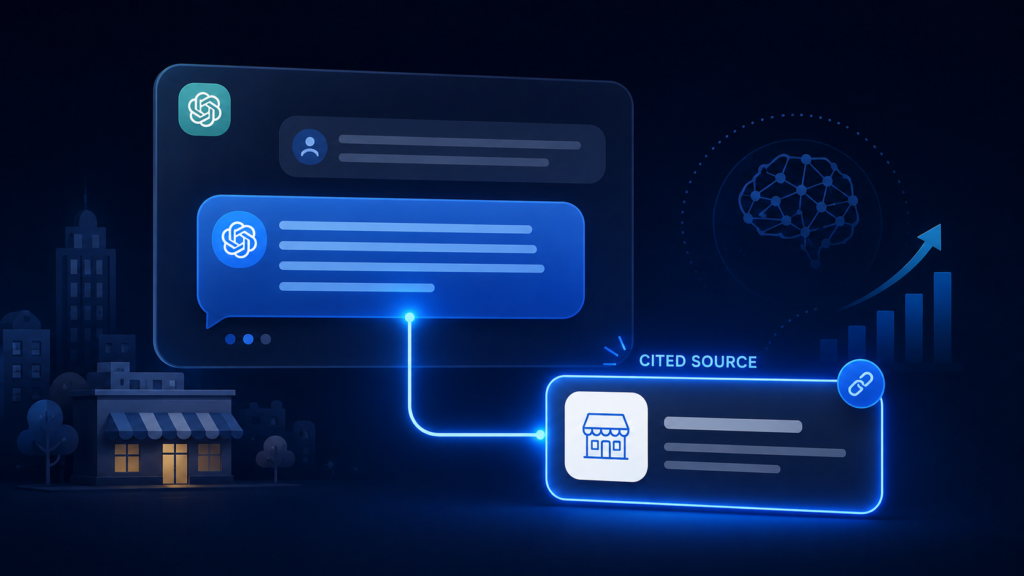
To get cited by ChatGPT, give it a clear, quotable answer to a specific question, keep your business facts identical everywhere online, and back it with real expertise like named authors and evidence. AI tools quote whatever is easiest to trust and lift. This guide shows you how to become that source.
More of your customers now ask ChatGPT before they ask Google. They type a question, read the answer, and that answer names a few sources. If yours is one of them, you just got recommended by a tool your customer already trusts. This is the core of what people call Generative Engine Optimization (GEO), and it isn’t luck or a keyword trick.
Search is splitting into two habits. Some people still scroll a page of blue links. A growing number just read the AI answer and act on it. When ChatGPT or Perplexity answers a buying question, it usually credits a handful of sources, and being one of them is the new version of ranking on page one.
The businesses that show up in those answers get the visit plus the credibility of being the one the AI picked. The ones that don’t stay invisible in that conversation, however good their actual service is. It’s already happening for questions your customers ask every week.
ChatGPT’s web answers pull from pages it can read, understand, and trust. Three things decide whether you make the cut.
Models quote the part of your page that answers the question directly. If that answer sits under a long warm-up, the model usually gives up and quotes someone tidier. The easier you are to quote, the more often you get quoted.
If your name, services, or location say one thing on your website and something else on your Google Business Profile, the model gets unsure. Unsure means it reaches for a safer, more consistent source instead of you.
A named author with a genuine bio, specific examples, and real numbers signals expertise. Anonymous “leading provider of quality solutions” copy signals nothing, and gets treated that way.
Pick one real question your customers ask. Put a direct answer in the first two or three sentences, then explain underneath. That opening block is what AI tools tend to lift. If a reader gets the answer from your first paragraph, you’re already ahead of competitors who make people dig for it.
A page that tries to cover your whole service rarely gets cited for anything, because it isn’t the clearest answer to any single question. Give each important question its own page or clearly headed section. Depth on one topic beats a shallow pass over ten.
Line up your name, address, phone, and service descriptions across your website, Google Business Profile, and listings. When these agree, AI tools trust the business behind them. When they conflict, you look like two half-finished businesses instead of one, and models quietly drop you for a cleaner source.
Put a real person’s name and short bio on your key pages. Add a specific result or a short client example, even a screenshot. Cite your source whenever you use a statistic. These are the same signals Google’s quality guidelines reward, and models lean on them too. Most sites are weakest here, which makes it the fastest place to stand out.
Use question-style headings that match how people ask (“How much does X cost?” beats “Pricing”). Keep sections short and self-contained so each one can be quoted alone. Add an FAQ for the smaller questions. Plain language wins here. If a sentence is hard for a person to skim, it’s hard for a model to lift.
Checking progress is simple. Every couple of weeks, type your customers’ real questions into ChatGPT and Perplexity and see whether your name comes up. Note the questions you’re close on and the ones you’re missing. That list becomes your next content plan.
Stuffing a page with a keyword did little for old SEO and does nothing for AI citation. Models answer questions, so write answers to questions.
A great answer in paragraph nine might as well not exist. If the model has to hunt for it, it moves on.
No author, no examples, no numbers. There’s nothing for a model or a reader to trust, so you get skipped.
It overlaps but isn’t the same. Good SEO helps because the page still has to be crawlable and trustworthy, but AI citation rewards clear, quotable answers and consistent facts more than keyword targeting. It’s often called GEO or AEO.
No. There are no ads inside AI citations today. You earn the mention by being the clearest, most trustworthy answer to the question, which is good news for smaller businesses willing to do the work.
Usually a few weeks to a few months, depending on how much authority your site already has and how competitive the question is.
Start with the questions closest to a sale, the ones people ask right before they buy or enquire. Winning those is worth more than ranking for broad, low-intent terms.
Getting cited by ChatGPT rewards what good businesses have always done: answer real questions clearly and prove you know your field. There’s no trick to game, which is why it’s a durable advantage once you build it.
If you want help becoming the source AI tools reach for, that’s what our AEO and GEO optimization service is built to do. Prefer to see where you stand first? Book a free AI visibility audit and we’ll show you which questions you’re already close to owning.
Aman Dubey works at the intersection of technology, digital marketing, and business growth. He enjoys turning complex topics like SEO, GEO, AI search, and web development into practical strategies that businesses can actually use.