
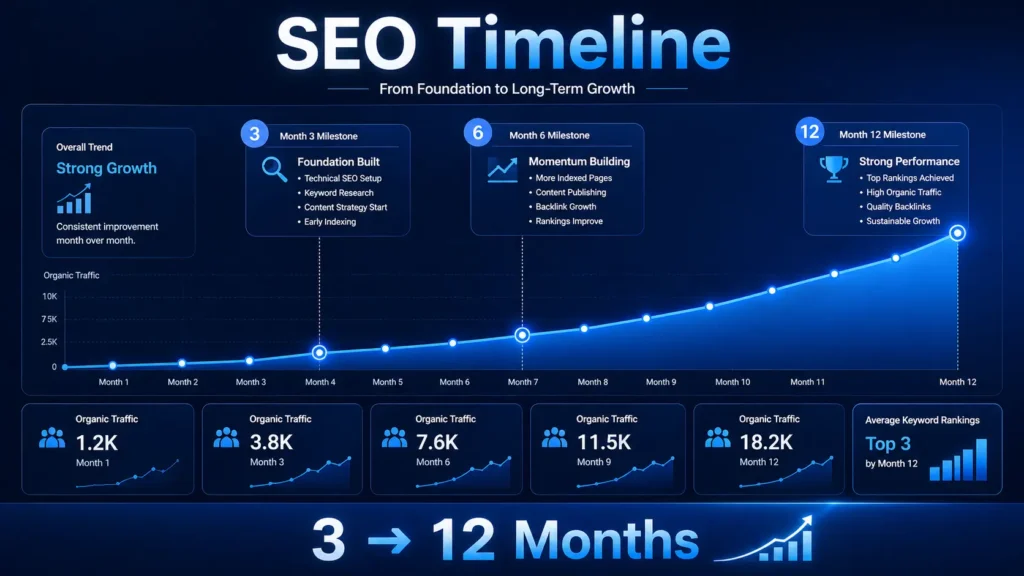
Every SEO agency in India has a stock answer to this question: “3 to 6 months.” It is technically true and practically useless.
The honest answer is more specific than that, and it depends on variables that most agencies do not want to explain upfront because the real answer sometimes pushes clients toward competitors who promise faster results.
This post gives you the actual picture: what happens in months 1, 3, 6, and 12, what makes results faster or slower, and what to do if you are not seeing movement.
For a new website targeting low-competition keywords in a local Indian market: first rankings in 6 to 10 weeks, meaningful organic traffic by month 4 to 5.
For an established website with existing traffic trying to rank for competitive national terms: noticeable improvement in 3 to 4 months, significant change in 6 to 9 months.
For a brand-new website targeting competitive national terms (e.g., “best SEO company India”): do not expect meaningful rankings in under 12 months. Any agency promising otherwise is either lying or targeting keywords nobody searches for.
Month 1 is for fixing problems, not generating traffic. A legitimate SEO engagement in month 1 covers: technical audit and fixes, keyword research and page mapping, on-page optimisation of existing pages, sitemap submission, Google Search Console setup.
You will not see ranking changes in month 1. If an agency claims you will, they are probably showing you rankings for keywords so obscure they have no competition and no search volume.
Google starts processing the changes. Pages that were previously weak begin moving. You may see:
This is the phase where patience is required. Movement is real but traffic change is not yet visible in Analytics.
This is when most clients start seeing something they can point to in Analytics. Rankings for targeted keywords reach page 1. Organic sessions begin increasing week on week. Local searches (if local SEO was part of the strategy) show Map Pack appearances.
For a local Bhopal business targeting “SEO agency Bhopal” or “web development company Bhopal”: first page rankings are achievable by month 3 to 4 because local competition is relatively limited. For “SEO company India” targeting national buyers: page 1 is not a month 4 to 6 outcome for a new site.
Pages that ranked on page 1 attract backlinks naturally. Backlinks improve domain authority. Higher domain authority helps other pages rank faster. Content published in month 2 starts ranking and driving traffic. Content published in month 5 starts appearing.
The compounding effect is real but only works if publication continues. Agencies that stop content production at month 3 see results plateau.
Competition level is the biggest factor. Targeting “digital marketing agency Bhopal” is different from targeting “digital marketing agency India.” A regional keyword with limited competition can yield page 1 results in 6 to 10 weeks. A national keyword with hundreds of established competitors takes a year or more.
Domain age and existing authority matter. An 8-year-old website with existing backlinks has a head start. A site launched this year starts from zero. Google takes time to trust new sites.
Technical health is a multiplier. A site with clean technical SEO (fast, mobile-friendly, no duplicate content, correct indexation) responds faster to on-page and content work. A site with technical problems is a leaky bucket — fix the leak first.
Content quality and frequency. Two well-researched, properly optimised blog posts per month published consistently outperforms 10 posts published in one batch and then nothing. Google rewards consistency.
AEO (featured snippets). Answer-optimised content can appear in featured snippet position within weeks on a new site. Google cares about the quality of the answer, not just domain authority, for these positions. Learn more about AEO
Targeting keywords that are too competitive too early. A startup competing for “best project management software India” against established SaaS review sites with thousands of backlinks will wait 18+ months for page 1.
Publishing and stopping. Three blog posts followed by 2 months of silence is worse than no content plan at all. It signals to Google that the site is not actively maintained.
Ignoring technical issues. A page that loads in 7 seconds, has duplicate meta titles, and is not mobile-friendly will rank below a technically clean competitor even with better content.
Not fixing Search Console errors. Coverage errors, Core Web Vitals failures, and Mobile Usability issues flagged in Search Console are not cosmetic. They directly affect how many pages are indexed and how they are scored.
Any agency that guarantees specific rankings within 30 or 60 days is making a promise they cannot keep. Google’s algorithm has over 200 factors; no agency controls it.
Agencies that report on keyword rankings only and not organic traffic or conversions are measuring the wrong thing. Rankings are inputs. Traffic and leads are outputs.
Agencies that cannot show you month-on-month Search Console data for your site are not being transparent. This data is freely available and should be shared in every report.
AEO (Answer Engine Optimization) targets featured snippets and People Also Ask boxes. These can appear faster than regular page 1 rankings because Google is looking for the clearest answer, not the most authoritative site.
A well-structured answer in the first 100 words of a page — 40 to 60 words, directly addressing a specific question — can earn a featured snippet within 3 to 6 weeks on pages that are already indexed. This is one of the fastest ways to appear at the top of search results on a newer site.
Yes. Local keywords with low competition, AEO-optimised content targeting featured snippets, and pages on established domains with existing authority can all show results in 4 to 8 weeks. The 3 to 6 month timeline applies to competitive keywords on newer sites.
Something is wrong. Either the keywords targeted are too competitive (realistic 12+ month timeframe), the technical issues are more severe than addressed, the content strategy needs adjustment, or the work claimed was not actually done. Ask for Search Console data showing impressions trend. If impressions are not growing, the site is not being discovered more. If impressions are growing but clicks are not, rankings are improving but not to page 1 yet.
For most Indian businesses competing in their local or regional market: yes. The compounding effect means month 12 delivers more than months 1 to 3 combined. For national competition, the timeline is longer. Calculate the customer lifetime value and ask how many leads per month would make SEO worthwhile at your monthly retainer cost.
Partially. Rankings held for several months with strong backlinks tend to hold for some time after activity stops. But competitors continue working, Google continues updating, and without fresh content and technical monitoring, positions slowly erode. Most businesses find that pausing for 3 to 4 months costs them 30 to 50% of the traffic gains.
SEO takes time. That is not a failure of the strategy — it is the nature of organic search. The businesses that benefit most are those that start early, stick to consistent execution, and measure the right things.
If you are not sure where your site currently stands or why your SEO is not moving at the pace you expected, a technical audit will tell you exactly what is blocking progress. Get a free SEO audit or explore our SEO services to see how we approach this for Indian businesses.
Content creator at Cogent Coders, sharing insights on digital marketing, web development, and business growth strategies.