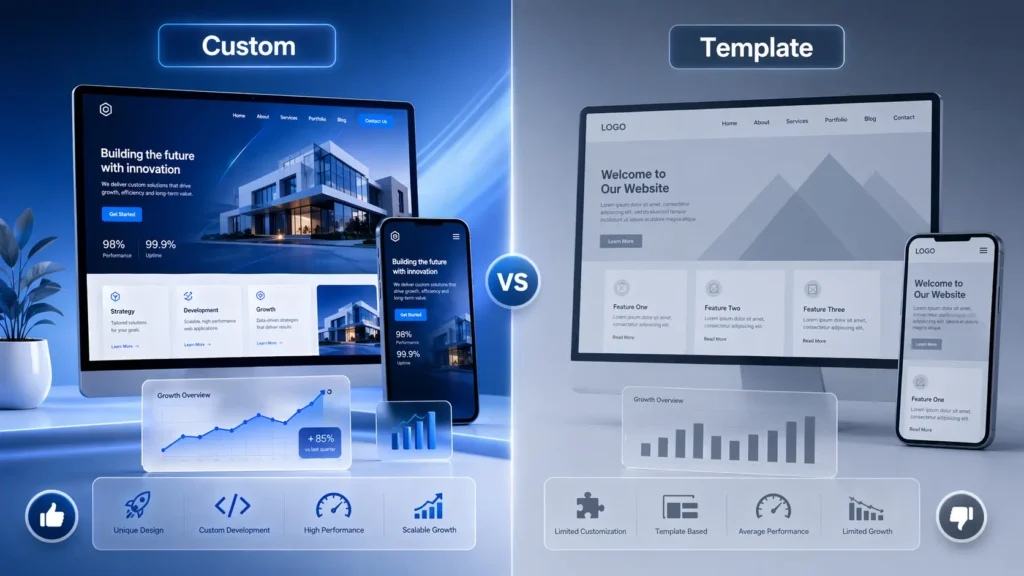
Custom Website vs Template: Which Is Right for Your Indian Business?
Introduction
When launching a business online, you face a fundamental choice: build a custom website from scratch or use a ready-made template?
It seems like a simple budget question. Templates are cheap (₹20,000–100,000). Custom sites cost significantly more (₹1,00,000–10,00,000+). But the real decision involves much more: scalability, SEO capability, brand differentiation, and long-term ROI.
This guide breaks down both options with real pricing, pros/cons, and when to choose each. By the end, you’ll have clarity on which path is right for your business.
What Is a Custom Website?
A custom website is built from scratch specifically for your business. Developers write the code (usually with React, Next.js, Vue, Laravel, or similar frameworks) to match your exact specifications, brand, and functionality needs.
Examples
- React/Next.js sites for fast, dynamic user experiences
- Laravel sites for complex backend functionality (inventory, bookings, payment systems)
- Headless CMS setups (WordPress headless, Contentful) for content flexibility
- Progressive Web Apps (PWAs) for mobile-like experience on browsers
Custom sites are built with your unique requirements in mind, no compromises.
What Is a Template Website?
A template website is built using pre-designed, ready-made themes or platforms. You customize colors, text, and images, but the underlying code and structure are pre-built.
Examples
- WordPress themes (Astra, Neve, Divi) — hundreds of themes available, customize with plugins
- Shopify stores — great for e-commerce, limited customization
- Wix/Squarespace — drag-and-drop builders, no coding needed
- WooCommerce setups — WordPress + e-commerce plugin
Templates are ideal for quick, affordable websites with standard functionality.
Head-to-Head Comparison: Cost, Speed, SEO, and More
1. Cost Comparison
Custom Website: ₹1,00,000–10,00,000+
- Design and planning: ₹25,000–50,000
- Frontend development: ₹40,000–200,000
- Backend/functionality: ₹30,000–300,000
- Hosting and domain: ₹500–2,000/month
- Why expensive: Every line of code is written specifically for you
Template Website: ₹20,000–100,000
- Theme purchase: ₹0–5,000 (many free themes available)
- Customization and setup: ₹15,000–50,000
- Plugins/extensions: ₹5,000–20,000
- Hosting and domain: ₹300–1,000/month
- Why cheaper: You’re customizing existing code, not writing new
2. Timeline
Custom Website: 6–16 weeks
- Discovery and design: 2–4 weeks
- Development: 3–8 weeks
- Testing and refinement: 2–4 weeks
- Launch: 1 week
Template Website: 1–4 weeks
- Theme selection and setup: 2–5 days
- Customization (colors, text, images): 1–2 weeks
- Content creation: 1–2 weeks
- Launch: 2–3 days
3. SEO (Search Engine Optimization)
Custom Website: Full Control
- Core Web Vitals optimization: ✓ Complete control over speed and performance
- Technical SEO: ✓ Can implement any structured data, hreflang, schema markup
- Site structure: ✓ Design the optimal URL structure and navigation
- Mobile optimization: ✓ Fully responsive from the ground up
- SEO advantage: Easier to rank, faster indexing, better performance metrics
Template Website: Limited Control
- Core Web Vitals: Some templates are slow; plugin bloat degrades performance
- Technical SEO: Plugins help, but templates have limitations
- Site structure: Less flexible; you’re stuck with the template’s structure
- Mobile: Most modern templates are mobile-friendly
- SEO advantage: Doable but harder; you compete with many sites using the same template
4. Scalability and Flexibility
Custom Website: Unlimited
- Add new features: Easy — just hire developers
- Integrate third-party tools: Flexible — can connect anything
- Handle growth: Scales effortlessly to millions of visitors
- Pivot business model: Rebuild sections without major overhaul
Template Website: Limited
- Add new features: Restricted by theme/platform capabilities
- Integrate tools: Limited to pre-approved plugins/integrations
- Handle growth: Can degrade with heavy traffic
- Pivot business model: Might need to switch themes or rebuild
5. Design and Brand Uniqueness
Custom Website: Fully Unique
- Your design is yours alone — competitors can’t copy your exact site
- Brand expression: 100% alignment with your brand guidelines
- Competitive advantage: Stand out visually in your market
Template Website: Generic
- Many businesses use the same theme — your site might look similar to competitors
- Brand expression: Limited to customization options within the template
Decision Framework: Which Should You Choose?
Choose Custom Website If:
- You need specific, complex functionality (marketplace, SaaS, complex e-commerce)
- You want complete design freedom and brand uniqueness
- You plan to scale significantly (100,000+ monthly visitors)
- You need advanced SEO optimization and control
- You operate in a highly competitive market and need technical edge
- You plan to stay with this website for 5+ years
Custom sites have higher upfront cost but lower lifetime cost if you factor in flexibility and scalability.
Choose Template Website If:
- You’re a startup on a tight budget (launch now, refine later)
- You need a website fast (launching in 2–4 weeks)
- Your needs are standard (blog, portfolio, small e-commerce store)
- You don’t expect to scale beyond 10,000 monthly visitors short-term
- You want minimal technical maintenance
- You’re testing a business idea before investing heavily
Template sites let you launch quickly. If your business grows beyond template limitations, you can migrate to custom later.
SEO Impact: Custom vs Template
For most businesses, custom websites have a 20–40% SEO advantage over template sites, depending on template quality. Here’s why:
- Custom sites load 50% faster (crucial for Core Web Vitals rankings)
- No plugin bloat that slows sites down
- Perfect mobile optimization from the ground up
- Can implement advanced schema markup without plugin limitations
- Unique content structure (not identical to thousands of other sites)
However, a well-optimized template beats a poorly built custom site every time. With good SEO optimization, template sites can rank, just with more effort.
Frequently Asked Questions
Can I move from template to custom later?
Yes, but it’s work. You’ll lose your domain history if you move domains. Best practice: if you know you’ll eventually need custom, start there. If unsure, launch with template and migrate if needed.
What’s the best template for SEO?
For WordPress, Astra and Neve are SEO-friendly. For e-commerce, Shopify is good for quick launches, but WooCommerce (custom) gives more SEO control. See our CMS WordPress guide for detailed comparisons.
Can a template site rank as well as a custom site?
Yes, if optimized properly. A custom site has structural advantages, but great content and optimization can overcome this. It just requires more effort on template sites.
What about e-commerce specifically?
For e-commerce, custom sites offer better performance, scalability, and inventory management. Shopify is good for quick launches; custom is better for serious scale.
Conclusion
Choose custom websites for long-term, scalable businesses with specific needs. Choose templates for fast, budget-conscious launches with standard needs.
Not sure which is right for you? Get a free consultation from Cogent Coders. We’ll evaluate your specific business needs and recommend the best path forward.