Introduction
Link building has been declared dead roughly once a year since 2012. It is not dead. It is just harder, slower, and less tolerant of shortcuts than it used to be.
For Indian websites specifically, link building has a particular problem: a large market of agencies selling cheap backlinks that work briefly, then damage the site when Google’s spam detection catches up. The Indian SEO market has more bad link-building advice per square kilometre than almost anywhere.
This guide covers what backlinks actually do, which tactics produce durable results in 2026, which ones produce penalties, and what a realistic link-building plan looks like for an Indian SME.
Why backlinks still matter
Google uses backlinks as a proxy for trust. When a reputable site links to yours, it is effectively vouching for your content. The more reputable sites that vouch for you, the more Google trusts your site. This trust — measured roughly as
domain authority — influences how well your pages rank, especially for competitive keywords.
For local and low-competition keywords, content quality and technical SEO can get you to page 1 without significant link building. For national or competitive terms, you will eventually need backlinks that your competitors do not have. There is no way around this.
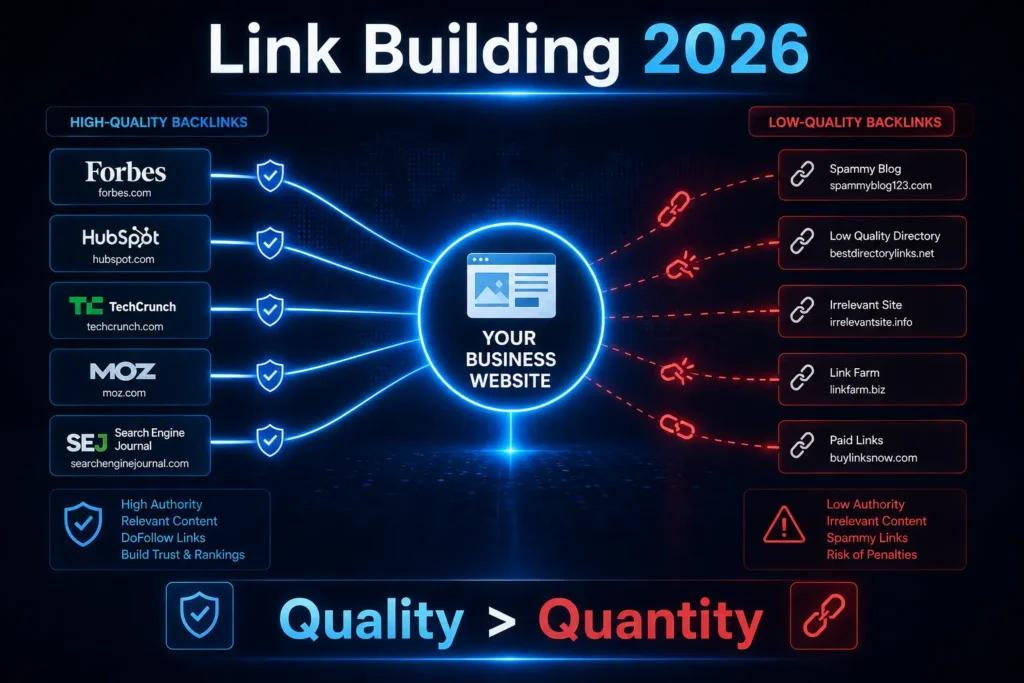
The key word is ‘reputable.’ A link from a genuine industry blog with real readers matters. A link from a site that exists only to sell links does not — and in many cases actively hurts your rankings.
Link quality: what makes a backlink valuable
Not all backlinks carry the same weight. Three factors determine how much a link is worth:
Relevance
A link from a web development blog to a web development agency is relevant. A link from a cooking site to the same agency is not. Google understands topical relevance. Relevant links carry more weight and look natural. Irrelevant links, especially in bulk, are a spam signal.
Authority of the linking site
A link from The Hindu, Economic Times, or a well-trafficked Indian industry publication is worth significantly more than a link from a 6-month-old blog with no real audience. The linking site’s own trustworthiness and traffic history matter.
Anchor text
The clickable text of a link. Exact-match anchor text (‘SEO agency Bhopal’ linking to your SEO page) passes keyword signals but looks unnatural if overused. A healthy backlink profile has a mix: branded anchors (‘Cogent Coders’), generic anchors (‘click here’, ‘this article’), and occasional keyword anchors. Portfolios made entirely of exact-match anchor text are a penalty trigger.
Link type comparison
| Link type |
Impact |
Risk |
Effort |
| Editorial mention in niche blog |
High |
None |
Medium |
| Business directory (Clutch, GoodFirms) |
Medium-High |
None |
Low |
| Guest post on relevant site |
Medium |
Low if relevant |
Medium |
| Journalist citation (HARO/Connectively) |
Very High |
None |
Medium |
| Resource page inclusion |
Medium |
None |
Low-Medium |
| Paid link farm / PBN |
Negative |
High (penalty) |
Low |
| Generic ‘comment backlinks’ |
Zero |
Low-Medium |
Low |
What actually works in 2026
1. Business directory listings
Free to low cost. High reliability. For Indian businesses, these are the starting point:
- co — most important for agencies and B2B service companies
- GoodFirms — strong domain authority, good for Indian IT and marketing firms
- DesignRush — design and development agencies
- Justdial and IndiaMART — local and national Indian directories
- Google Business Profile — not a traditional backlink but influences local rankings
These links are not high authority individually, but they establish your business entity consistently across the web, which matters for both SEO and for GEO (being cited by AI search engines).
2. Content-earned links
The most durable link-building strategy: publish something worth linking to, and let other sites link to it naturally.
What earns links in the Indian market:
- Original data and research (salary surveys, pricing reports, industry statistics)
- Comprehensive guides that are genuinely more useful than what currently ranks
- Free tools, calculators, or templates (an SEO audit checklist, a website cost calculator)
- Opinion pieces on industry trends that journalists or bloggers cite
This approach is slow. A piece of content that earns 10 links over 6 months is more valuable than 50 purchased links that Google discounts within weeks. But it compounds — a well-linked resource keeps attracting new links over years.
3. Digital PR and journalist outreach
Journalists and bloggers covering technology, business, and digital marketing in India frequently need expert quotes, data, and commentary. Getting cited in an Economic Times or YourStory article earns a high-authority backlink and brand visibility.
How to get there: build a list of journalists covering your beat. Follow them on LinkedIn. When they post asking for expert input, respond quickly and specifically. Connectively (formerly HARO) has an India-relevant stream worth monitoring.
This takes time to build relationships but the links earned are exactly the kind Google values most.
4. Guest posting on relevant industry sites
Writing an article for a genuine industry publication that accepts guest contributors. Not link farms disguised as blogs — actual publications with real editors and real readers.
Indian publications worth approaching for technology and digital marketing topics: YourStory, Inc42, Entrackr, Entrepreneur India, Analytics India Magazine. Each has its own submission guidelines and editorial standards.
One rule: the guest post must be genuinely useful to that publication’s audience. An article written only to get a link will be rejected or, if published, will not earn meaningful traffic or secondary links.
5. Broken link building
Find pages on relevant Indian websites that link to URLs returning 404 errors. Contact the site owner, point out the broken link, and suggest your relevant content as a replacement. This works because you are solving a problem for the site owner, not just asking for a favour.
Use
Ahrefs’ broken link checker (free tier available) to find broken links on sites in your niche.
6. Reclaiming unlinked brand mentions
Find sites that mention your business name without linking to you. These are easy wins — the site already knows you exist and has written about you. A polite email asking them to add a link converts at a higher rate than cold outreach.
Set up a Google Alert for your brand name. Review mentions monthly. For larger-scale monitoring,
Ahrefs Content Explorer can find unlinked mentions across the web.
What gets Indian websites penalised in 2026
Link farms and private blog networks (PBNs)
Networks of sites created specifically to sell links. They often have legitimate-looking design but no real audience, thin content, and link profiles that show unusual patterns. Google’s spam algorithms have become significantly better at identifying these. Sites that buy PBN links see short-term gains followed by ranking drops when the network is devalued or manually reviewed.
Fiverr and cheap bulk link packages
Common in the Indian market: agencies selling 100 backlinks for ₹5,000. These links come from low-quality directories, forum spam, and comment sections. Some are on sites that Google has already deindexed. These links either do nothing or actively suppress rankings.
Exact-match anchor text in bulk
Getting 30 links all with the anchor text ‘SEO agency Bhopal’ looks manipulative. Real backlink profiles have varied anchors. An unnatural anchor text pattern triggers algorithmic filtering or manual review.
Reciprocal link exchanges at scale
‘I link to you if you link to me’ is fine in small doses between genuinely related sites. At scale, it is a link scheme. A pattern of reciprocal links across dozens of sites is detectable and penalised.
A realistic link-building plan for Indian SMEs
For a business with limited time and budget, this is the order of priority:
- Set up all major business directory listings (Clutch, GoodFirms, Justdial, IndiaMART) — 1 to 2 days of work, done once
- Publish 1 to 2 genuinely useful pieces of content per month — aim for content that answers questions your industry gets asked constantly
- Set up Google Alerts for your brand name — reclaim unlinked mentions as they appear
- Identify 5 to 10 relevant Indian publications and follow their journalists — respond to relevant journalist queries when they arise
- After 3 to 4 months of content, begin broken link building outreach targeting relevant Indian sites — 10 to 15 outreach emails per week is manageable alongside other work
This approach builds 5 to 15 quality backlinks per month over time. It is slower than buying links. It is also what produces durable page 1 rankings that do not disappear after a Google update.