Introduction
Keyword research is not just finding words with high search volume. That is step three of six. The businesses that do it badly spend months creating content that nobody finds, or content that attracts visitors who were never going to buy.
India has some specific characteristics that change how keyword research works: lower average search volumes than Western markets, strong regional and language variation, and competitive dynamics that differ significantly by city and niche. Generic keyword research advice written for US markets does not always apply.
This guide covers the full process, from setting up your tools to mapping keywords to the right pages, with India-specific considerations at each step.
Step 1: Set up Google Search Console first
Before researching new keywords, find out which keywords you already appear for. Search Console shows you exactly which queries triggered your pages in Google, how many impressions each got, and how many clicks. This is free, takes 10 minutes to set up, and shows you real data from your actual audience.
Go to
Google Search Console, add your site, and look at the Performance report. Filter by country: India. Sort by Impressions descending.
What to look for: queries where you have 50 to 500 impressions but a low click-through rate (under 3%). These are pages that are appearing in search but not ranking high enough to get clicks. These are your quickest wins — the keywords are already relevant to your site, you just need to move up a few positions.
Step 2: Understand search intent before volume
Volume without intent is noise. A keyword getting 10,000 searches per month from people looking for free information will not drive business leads. A keyword getting 400 searches per month from people ready to hire will.
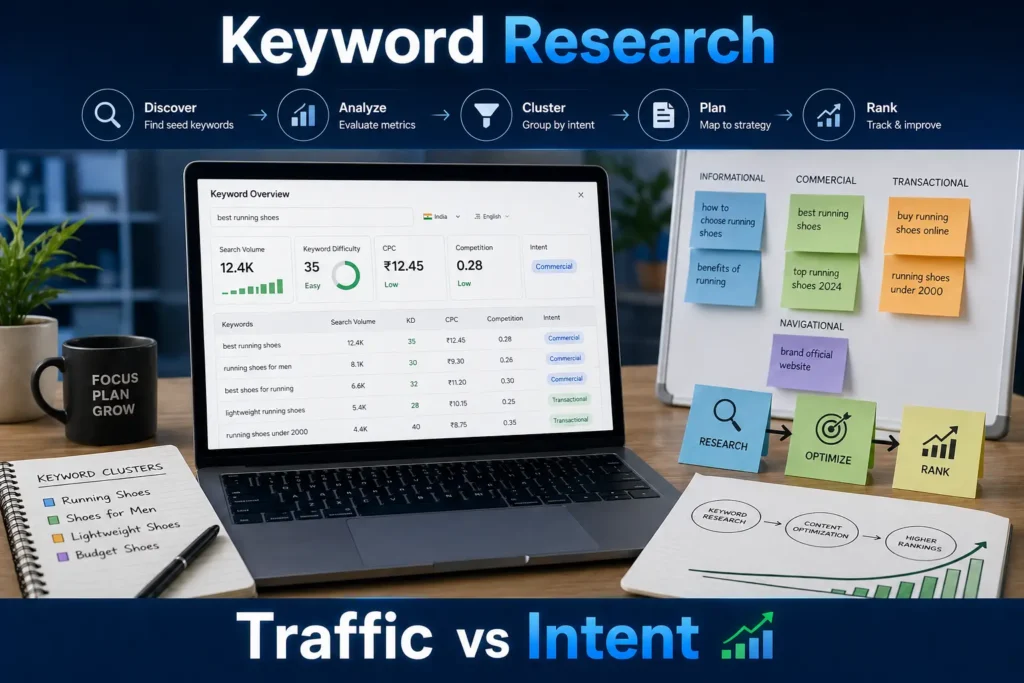
Four types of search intent:
| Intent type |
What the user wants |
Example keyword |
Content to create |
| Informational |
Learn something |
what is technical SEO |
Blog post, guide |
| Navigational |
Find a specific site |
Cogent Coders contact |
Homepage, About page |
| Commercial |
Compare options |
best SEO agency Bhopal |
Comparison, case study |
| Transactional |
Ready to buy/hire |
SEO services India pricing |
Service page, pricing |
Match your content type to the intent of the keyword. A transactional keyword like ‘SEO services pricing India’ needs a service or pricing page, not a blog post. A blog post will rank but will not convert. An informational keyword like ‘what is technical SEO’ is perfect for a blog post — do not send it to your homepage.
Step 3: Use free tools to find Indian keyword data
Google Keyword Planner
Free with a Google Ads account. Set location to India. Shows search volume ranges and keyword ideas. The ranges are broad (1K to 10K rather than exact numbers) but useful for comparing which keywords have meaningful demand versus which are essentially unsearched.
Start with 3 to 5 seed keywords that describe your service or product. Enter them, set location to India, and look at the suggestions. Sort by competition (Low first) and look for keywords with at least 100 to 1,000 monthly searches.
Google Autocomplete and People Also Ask
Type your seed keyword into Google and look at the autocomplete suggestions. These are what real Indian users are actually searching for. ‘SEO’ autocompletes differently in India than in the US.
Scroll to the People Also Ask box on the results page. Every question in that box is a keyword someone is searching for. These are especially useful for AEO content — a blog post that directly answers a PAA question can earn a featured snippet quickly.
Google Trends
Free. Shows whether a keyword’s search interest is growing, flat, or declining. Filter by India, last 12 months. If two keywords have similar volume but one is trending upward, the upward one has more long-term value. Also shows regional interest — useful for identifying whether a keyword is stronger in your city or state.
Search Console (existing pages)
Already covered in Step 1, but worth repeating: your own Search Console data is more reliable than any third-party tool for understanding what your current audience actually searches for.
Step 4: Local vs national keywords — a critical India distinction
Indian search behaviour splits sharply between local intent and national intent, and the competition levels are very different.
Local keywords
‘SEO agency in Bhopal’, ‘web development company Indore’, ‘digital marketing agency Nagpur’ — these have lower search volume but much lower competition. A well-optimised local page and a strong Google Business Profile can reach the top 3 positions in 6 to 10 weeks. For any business serving a specific city or region, these are where you start.
National keywords
‘SEO agency India’, ‘best web development company India’ — higher volume, significantly more competition. Page 1 rankings for these against established national agencies take 12 months or more for a site with limited domain authority. Target these with long-form content over time, not as your first priority.
The tier-2 and tier-3 city opportunity
Most Indian SEO competition is concentrated in Mumbai, Delhi, Bengaluru, and Hyderabad. Businesses in Bhopal, Indore, Nagpur, Jaipur, Surat, and similar cities face a fraction of the competition for both local and regional keywords. A Bhopal agency ranking for ‘digital marketing Madhya Pradesh’ faces far less competition than one trying to rank for ‘digital marketing Mumbai’.
Step 5: Evaluate keywords before committing
Not every keyword with decent volume is worth targeting. Before adding a keyword to your content plan, check three things:
Who is already ranking?
Search the keyword in Google and look at page 1. If results are dominated by Wikipedia, major news sites, Amazon, Flipkart, or large national portals, you will struggle to displace them. If results include smaller business sites, agency blogs, or local directories, you have a realistic shot.
What does the content look like?
Read the top 3 results. How long are they? How detailed? Do they answer the question well? If the top results are thin, outdated, or do not fully address the search intent, you can outperform them with better content. If the top results are comprehensive 3,000-word guides from authoritative domains, you need to write something significantly better — or find a different keyword.
Does the intent match what you can offer?
A keyword like ‘free SEO tools India’ attracts people who do not want to pay for services. Ranking for it brings traffic that will not convert for an agency. Make sure the intent behind the keyword aligns with what you are selling or offering.
Step 6: Map keywords to pages
Every keyword needs a home: one specific page that targets it. This is called keyword-to-page mapping. Getting this wrong is how you end up with five blog posts all competing for the same phrase.
The rules:
- One primary keyword per page
- 3 to 5 secondary keywords that share the same intent go on the same page
- If two keywords have very different intent, they get separate pages
- Service pages target transactional keywords. Blog posts target informational keywords. Do not mix them.
Build a simple spreadsheet: one row per keyword, columns for search volume, intent type, target page URL, and status (planned / in progress / live). Update it as you publish. This prevents keyword cannibalisation — where multiple pages on your site compete for the same term and end up ranking worse than a single focused page would.
Step 7: Hindi and regional language keywords
B2B searches in India happen predominantly in English, even among non-native English speakers. A business owner looking for an SEO agency types ‘SEO agency Bhopal’ in English.
Consumer searches in tier-2 and tier-3 cities are shifting. Searches for local services, products, and information increasingly happen in Hindi and regional languages. If your audience is consumers in these markets, a Hindi keyword strategy is worth building over time.
How to identify which language your audience uses: check your Search Console queries. If you are already getting Hindi-language impressions, your audience is already searching in Hindi. If all your queries are in English, start there.
Do not translate your English keywords directly into Hindi and assume they map to the same intent. Run the Hindi keyword through Google Trends India and look at what the actual autocomplete suggests. Search intent can differ significantly between languages for the same topic.