
Most Indian e-commerce SEO guides recycle the same generic advice: add keywords to your titles, write product descriptions, get backlinks. This post goes further.
E-commerce SEO is different from service website SEO. You have hundreds or thousands of pages. Duplicate content is a structural risk. Category pages matter as much as product pages. And the technical setup on Shopify versus WooCommerce creates different problems to solve.
This guide covers what actually moves rankings for Indian online stores in 2026.
Volume creates complexity. A store with 500 products has 500 product pages that all need unique titles, descriptions, and proper schema. A blog with 50 articles is simpler to manage.
Duplicate content is endemic. Many Indian stores use manufacturer descriptions copied from supplier catalogues. These descriptions exist on dozens of competitor sites. Google sees them as duplicate content and does not rank any of them well.
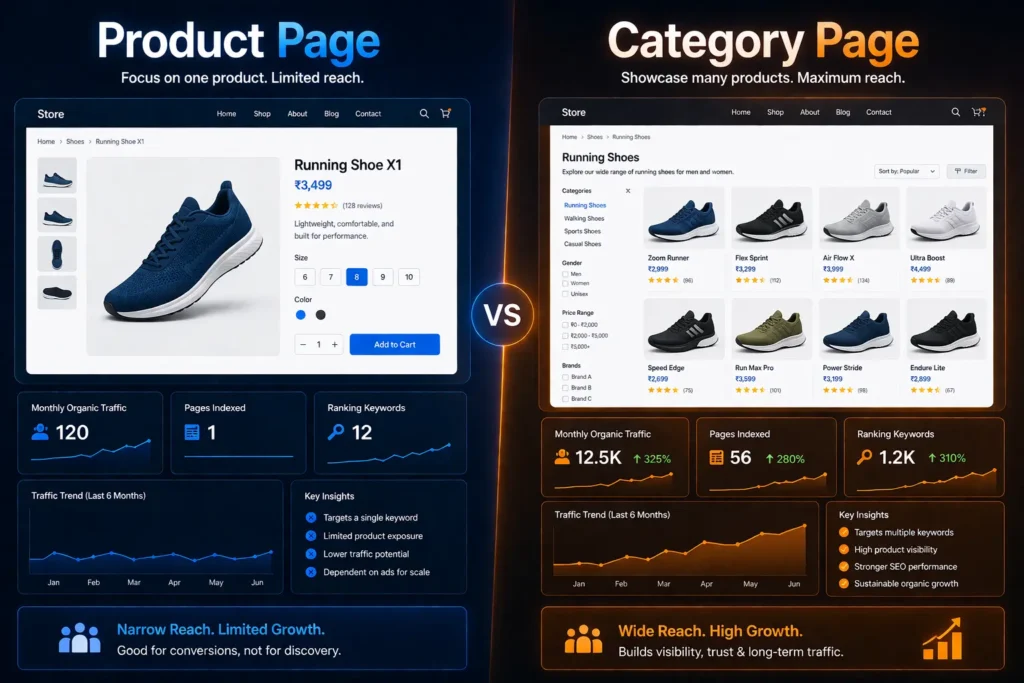
Category pages are often ignored. Most store owners obsess over product pages and ignore category pages. Yet “men’s running shoes India” is searched far more often than “Nike Air Zoom Pegasus 41.” Category pages rank for those broader searches.
Thin pages hurt the whole site. A store with 200 pages that have 50-word descriptions and nothing else has what Google calls “low-quality content” at scale. This suppresses the entire domain’s ranking potential, not just those individual pages.
Shopify makes some SEO tasks easy and others harder.
Built-in: automatic XML sitemap, canonical tags on product variants, SSL, responsive themes, fast CDN.
Limitations: URL structure is fixed — products always have /products/ in the URL and collections always have /collections/. You cannot change this. For most stores this does not matter, but for stores where URL structure is important for keyword targeting, it is a limitation.
Shopify also appends ?variant=XXXXXX to product URLs for variant pages, which can create duplicate content issues if not handled with canonical tags (Shopify does this automatically but check it is working).
Apps for SEO: JSON-LD for SEO, SEO Booster, Plug in SEO are the most used. Most stores should install one to handle schema markup.
WooCommerce gives more control but requires more work.
Yoast SEO or Rank Math integration is straightforward and covers meta titles, descriptions, sitemaps, and schema for products. Breadcrumb schema is built into both plugins.
URL structure is fully customisable. You can set product URLs to /shop/product-name/ or just /product-name/ — a minor but sometimes useful flexibility.
Common WooCommerce problems: sites on shared Indian hosting (Hostinger, GoDaddy shared plans) with 300+ products often have LCP above 6 seconds. WooCommerce is heavier than Shopify for hosting infrastructure. A VPS or managed WordPress hosting (like Kinsta or Cloudways) is worth the cost for stores above 200 products.
Write your own. Not the manufacturer’s copy. Not AI-generated filler. A 200 to 300-word description that answers the questions a buyer has before purchasing: what is it, who is it for, what are the dimensions/specs/materials, why buy from you rather than Amazon?
This is the single highest-impact SEO change most Indian stores can make.
Target keyword first, then specifics. “Men’s Running Shoes — Air Mesh, Size 7-12, Black | StoreName” performs better than “Nike-Style Running Shoe | Our Store | Buy Online”.
Every product page should have Product schema with price, availability, review aggregate, and SKU. This generates star ratings and price in Google search results. On Shopify, use an SEO app. On WooCommerce, Yoast SEO Premium or Rank Math Pro handles this.
Product images are usually the largest files on a page. Compress to WebP, keep file sizes under 100KB where possible, and add descriptive alt text with the product name and primary keyword.
Category pages rank for the high-volume, high-intent searches: “women’s kurtas India”, “budget laptops under 50000”, “Ayurvedic skincare India”. These are the terms that drive volume.
What a good category page needs:
Most Indian stores have category pages with just a product grid and nothing else. Adding even 150 words of descriptive content consistently moves category rankings.
Filter pages (colour=red, size=M, brand=Nike) create thousands of URL combinations. Most of them are near-duplicate content. Set these filter URLs to noindex or use canonical tags pointing to the base category page. On Shopify, filtered collection URLs are handled automatically with canonical tags. On WooCommerce, configure your SEO plugin to noindex filtered pages.
Do not delete out-of-stock product pages. They may have backlinks and ranking history. Return a 200 status with a message that the item is temporarily out of stock and show similar products. Delete only if the product is permanently discontinued, and then set a 301 redirect to the most relevant category.
Product pages with 10+ high-resolution images are slow. Use lazy loading (images below the fold load only when scrolled to), WebP format, and a CDN. On Shopify, these are handled by the platform. On WooCommerce, install ShortPixel or Imagify for image compression and Cloudflare for CDN.
E-commerce sites get links differently from service sites. Useful approaches:
Avoid: buying backlinks from link farms. Google’s spam detection has improved significantly. Paid links from low-quality directories generate penalties, not rankings.
Product pages targeting low-competition specific terms can rank in 4 to 8 weeks. Category pages for competitive terms (women’s clothing India, electronics) take 6 to 12 months. New stores should focus on long-tail product keywords first.
Neither has a significant advantage in ranking potential. Shopify wins on speed and technical defaults. WooCommerce wins on URL flexibility and customisation. Choose based on your business needs; optimise for SEO on whichever you use.
You do not need to rewrite all of them immediately. Prioritise your top 20 to 30 best-selling products first. Unique, useful descriptions on your most important pages deliver the most impact. Work through the catalogue over 3 to 6 months.
Optimising category pages. Most stores ignore them. They drive more volume than individual product pages because they match how most buyers search when they are still deciding what to buy.
E-commerce SEO in India is winnable even against larger competitors if you focus on what most stores skip: unique product descriptions, optimised category pages, and clean technical structure. Shopify and WooCommerce both support strong SEO — the platform matters less than how well you use it.
For a full e-commerce SEO audit covering technical setup, product page health, and category optimisation, get a free SEO audit or explore our e-commerce development services.
Content creator at Cogent Coders, sharing insights on digital marketing, web development, and business growth strategies.