Introduction
Most Indian business owners hear “content marketing” and “SEO” used interchangeably. They are not the same thing. They overlap significantly, but they have different goals, different timelines, and different costs.
Getting this distinction wrong leads to one of two mistakes: investing only in content and wondering why it does not rank, or investing only in technical SEO and wondering why traffic does not convert. Both matter. But they matter differently depending on where your business is right now.
What SEO actually is
SEO (Search Engine Optimization) is the practice of getting your website’s pages to rank higher in Google for specific search queries. It includes:
- Technical SEO: crawlability, site speed, schema markup, mobile optimisation
- On-page SEO: keyword targeting, heading structure, meta titles, internal linking
- Off-page SEO: backlinks from other sites pointing to yours
- Local SEO: optimising for Google Maps and location-based searches
SEO is concerned with the mechanics of ranking. A page can be technically well-optimised but thin on content and still rank if competition is low.
What content marketing actually is
Content marketing is the practice of creating and distributing content that attracts and engages your target audience, usually with the goal of building trust and generating leads over time.
Content marketing includes:
- Blog posts, guides, and how-to articles
- Videos, podcasts, infographics
- Email newsletters
- Social media content
- Case studies and client stories
Content marketing does not require SEO to exist. A business can run a content marketing strategy entirely through social media and email, with no interest in Google rankings at all.
Where they overlap
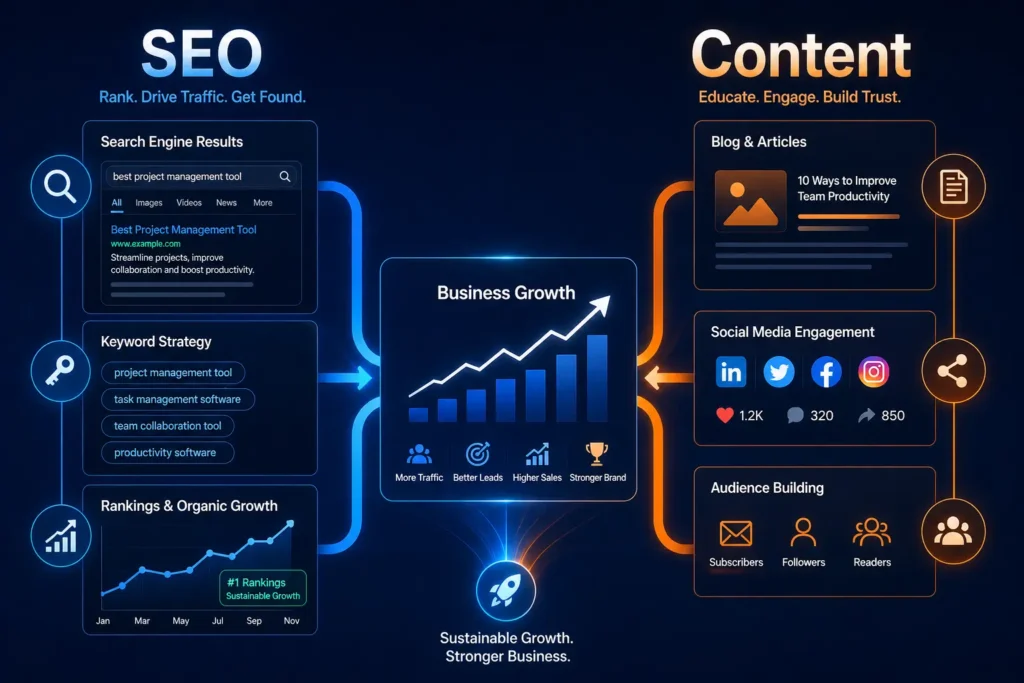
The most effective digital marketing in 2026 sits at the intersection. When you write a blog post targeting a keyword your audience searches for, you are doing both simultaneously.
Blog content is the most common overlap point. A 1,500-word article on “how to choose the right SEO agency in India” is:
- Content marketing (builds trust, demonstrates expertise, attracts potential clients)
- SEO (targets a keyword, earns backlinks if good, appears in search results)
Neither discipline is complete without the other. Pure SEO without content has nothing to rank. Pure content marketing without SEO leaves traffic on the table.
Where they differ
Timeline
SEO takes 3 to 6 months to show ranking results. Content marketing can generate social shares and email subscribers faster but requires sustained effort to build meaningful audience size.
Measurement
SEO is measured in rankings, organic traffic, and click-through rates. Content marketing is measured in engagement, leads generated, email signups, and brand recall.
Cost structure
Technical SEO is a one-time fix for many issues. Content marketing is an ongoing investment — you cannot publish 10 articles and stop. It requires consistent publication.
Goal
SEO brings people to your site who are already searching for what you offer. Content marketing can reach people who are not yet looking, building awareness before they have a need.
SEO vs Content Marketing: A Quick Comparison
|
SEO |
Content Marketing |
| Goal |
Drive organic search traffic |
Build audience and trust |
| Timeline |
3-6 months for results |
6-12 months for meaningful audience |
| Measurement |
Rankings, organic traffic |
Engagement, leads, email list |
| Cost Structure |
Upfront audit + ongoing |
Ongoing (cannot stop) |
| Best For |
Capturing demand that exists |
Creating demand that does not yet exist |
Do you need both?
For most Indian businesses: yes, eventually. But not necessarily at the same time from day one.
If you are a new business
Start with basic technical SEO (get the site indexed and structured correctly), then build content around the 3 to 5 keywords your buyers actually search. Do not invest in broad content marketing until you have a working SEO foundation.
If you are an established business with an existing audience
Content marketing may deliver faster results because you have distribution. But add SEO to every piece you publish. Keyword research takes 30 minutes per article and compounds returns over months.
If you have a limited budget
SEO usually has better return on investment in the early stages because it captures existing demand. Content marketing is most powerful once you have an audience to distribute to.
How to allocate budget between them
There is no universal split. A useful starting framework:
Month 1 to 3
70% SEO (technical fixes, keyword research, on-page optimisation), 30% content (2 to 3 foundational blog posts targeting high-intent keywords).
Month 4 to 6
50/50 — continue SEO monitoring, increase publishing to 4 to 6 posts per month.
Month 7 onwards
Rebalance based on what is working. If organic traffic is growing, content compounds it. If social or email is driving more leads, invest more there.